16.25x21x4 Air Filters for Pet and Allergen Homes
TL;DR
16.25x21x4 is an odd filter slot size, and the nearest common filters (16x20x4 and 16x25x4) will not seal it. The EPA reports that a filter in a poorly matched frame lets air leak around it, and that bypassed air carries dust back into ducts you just paid to have cleaned. Confirm the size first, then choose MERV.
A 16.25x21x4 air filter is a four-inch-deep pleated HVAC filter built for a return slot measuring roughly 16.25 by 21 inches. It is a true odd size with no standard substitute. Measure the slot, match the published actual dimensions, then pick MERV 13 if your system takes it and MERV 11 if not.
Key Takeaways
Fit outranks rating. The EPA attributes substantial losses in filter effectiveness to air leaking around a filter in a poorly matched frame or gasket.
This size breaks the undercut convention. Most nominal sizes arrive about half an inch smaller than the label. This one does not.
MERV 13 is the EPA’s target, or as high as your system allows. MERV 11 is the fallback.
Never cut a larger filter to fit. Trimming destroys the sealing edge and creates the exact gap you are closing.
Pets shorten the interval: about 60 days against a 90-day baseline.
Why Does a 16.25x21x4 Slot Need an Exact-Size Filter?
Because the filters beside it on a shelf are not close enough. A 16x20x4 falls short by a quarter inch on one face and a full inch on the other, and a 16x25x4 does not fit at all. In a filter rack, that gap is an open channel, and air takes the path of least resistance.
Most sizes are undercut: order a nominal 16x25x4, and it arrives at about 15.5 by 24.5 inches, deliberately shy of the label so it seats without binding. This size does not follow that pattern on its faces.
Depth is shaved on both, as on nearly every four-inch filter, but the faces are where the convention breaks. Anyone who has replaced a standard filter has learned “order nominal, receive smaller,” and that instinct produces a filter here that will not seat.
What If It Does Not Fit, or You Cannot Find This Size?
Do two things. First, confirm you have this size and not a near neighbour, because 16.25x21x4 belongs to a family separated by a quarter inch. Second, do not cut a larger filter down.
Live products sharing the same 16.25-inch short face include 16.25x21.25x4, 16.25x21x1, 16.25x21.25x1 and 16.25x21.5x1. If your short face measured 16.25, measure the long face twice and the rack depth once before ordering.
Trimming fails badly. Cutting the frame destroys the rigid edge that seals against the rack, and cutting the pleat pack opens the media, creating the bypass gap you were avoiding. Filter King, a competitor, warns against this on its own size pages, which carries weight because they profit from selling a bigger filter to cut. If the size is unavailable, order a custom-built filter instead.
How Does Filter Fit Affect Duct Cleaning Results?
Directly. A duct cleaning removes debris from the ducts, registers, coils, and air handler housing, and how long that lasts depends on what enters afterward. Everything entering passes through one filter, or around it. A filter that does not seal is a duct cleaning with a leak.
The EPA’s duct cleaning guidance recommends preventive maintenance whether or not you clean: use the highest-efficiency filter your manufacturer recommends, change it regularly, and make sure no air bypasses it through gaps around the holder. Its technical summary on residential air cleaners names the mechanism: effectiveness drops substantially when air leaks around a filter in a poorly matched or poorly constructed frame.
ASHRAE’s filtration guidance adds the consequence: air travelling around a filter is never cleaned, so a loose filter performs like a cheaper one. A slightly loose slot can often be fixed with tape.
Which MERV Rating Is Right for Pets, Pollen, and Dust?
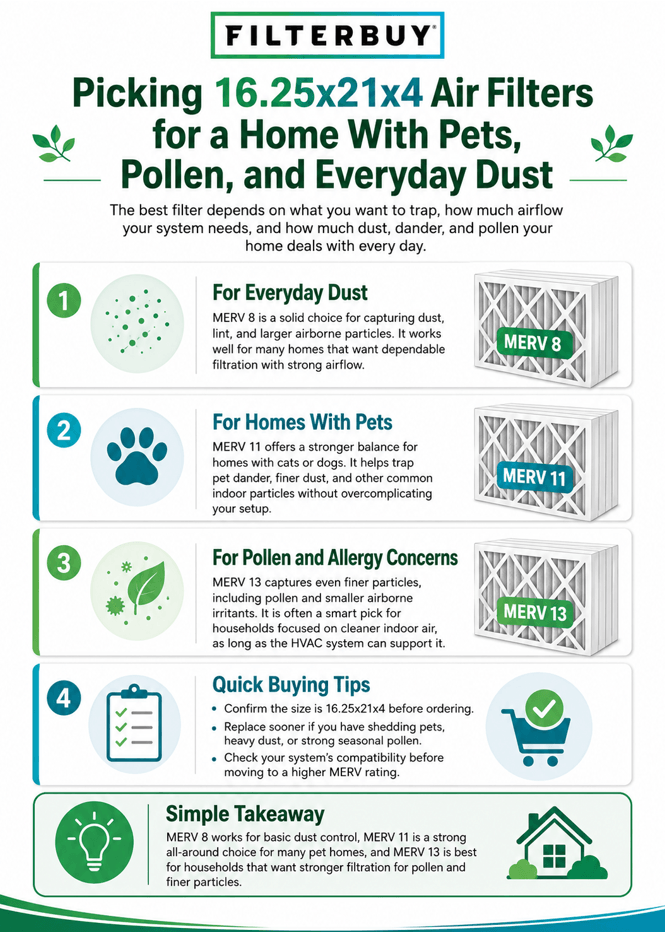
Aim for MERV 13 if your system handles it, MERV 11 if not. That is the EPA’s framing: at least MERV 13, or as high as your system allows. At four inches deep, most modern systems manage MERV 13 without strain, because the depth spreads airflow across more media area.
The EPA notes that much cat and dog allergen rides on small particles, which stay airborne longer and are more likely to be caught by a filter, so MERV 13 helps a pet household rather than being overkill. Filtration is still only part of the job: larger particles settle onto floors quickly and need routine cleaning. If your system is older or the return is undersized, check the manual first.
How Often Should You Change a 16.25x21x4 Filter?
Ninety days is the baseline for a four-inch filter, 60 with shedding pets, and roughly six weeks with asthma or heavy seasonal allergies. If the filter looks loaded before the interval ends, the interval is wrong.
ENERGY STAR gives the simplest rule: check monthly during heavy heating and cooling months, change it if it looks dirty, never exceed three months. An overloaded filter is not harmless either, since rising pressure drop can increase bypass around it.
How Do You Confirm Your Slot Is Really 16.25x21x4?
Measure the opening itself, not just the old filter, since the last technician may have installed the wrong size.
Turn the system off at the thermostat.
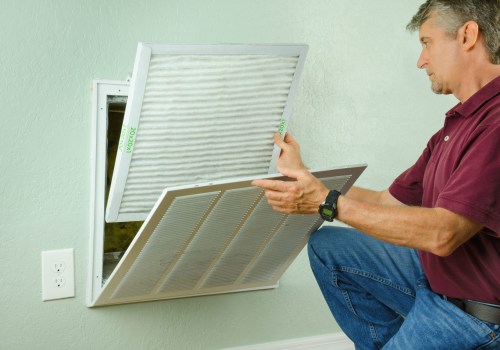
Slide the old filter out and read the frame, which usually lists a nominal size in large type and an actual size in smaller type.
Measure the short face, long face, and rack depth to the nearest eighth of an inch.
Compare against the seller’s stated actual size, not the nominal one.
Step four addresses odd sizes and needs a seller who publishes both numbers. Filterbuy is a U.S. air filter manufacturer that makes pleated HVAC filters in more than 600 standard and custom sizes, shipped factory-direct from Talladega, Alabama.
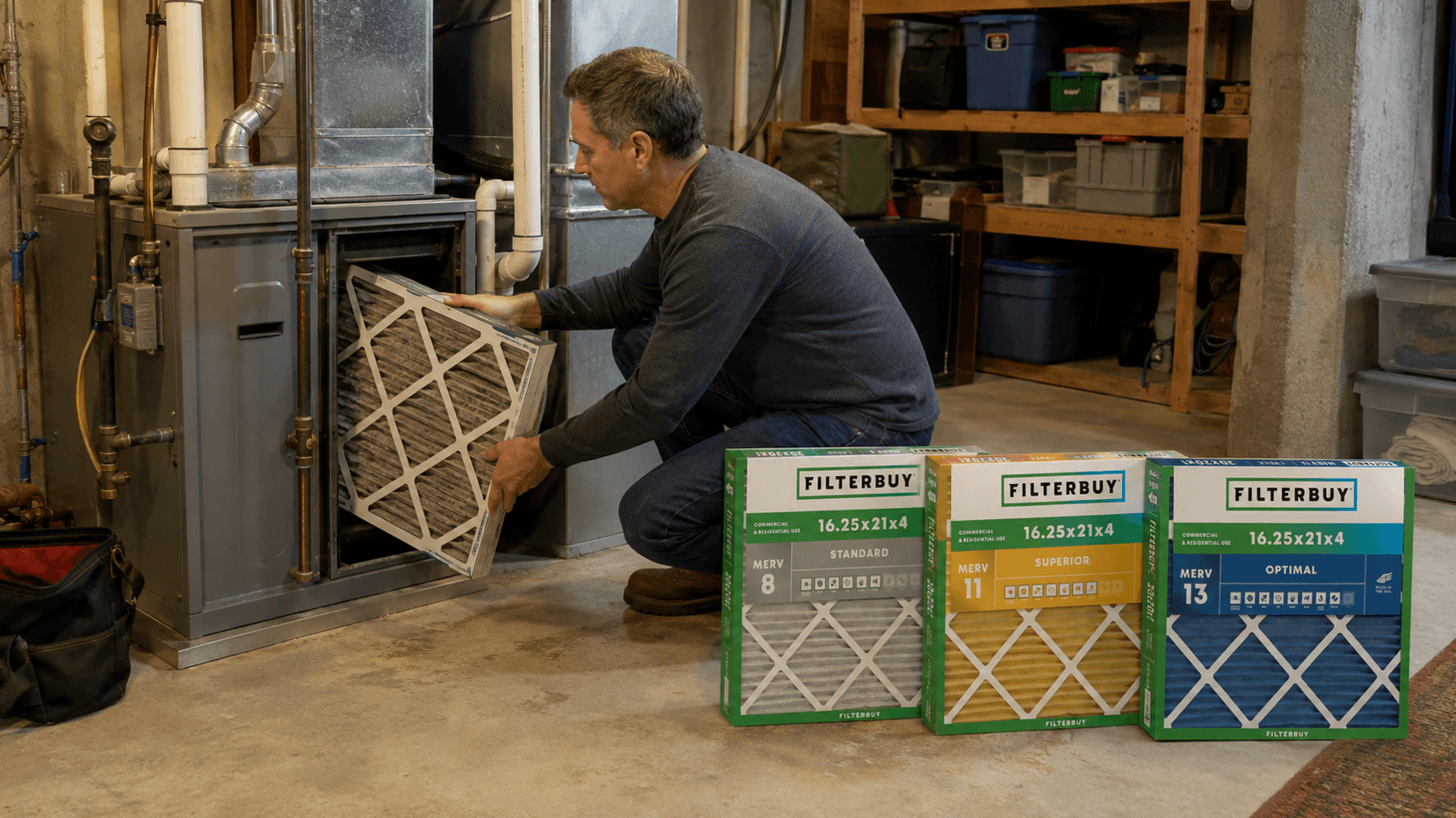
Filterbuy lists the actual dimensions of its 16.25x21x4 pleated HVAC air filter as 16.25 x 21.00 x 3.63 inches, in MERV 8, MERV 11, and MERV 13 (product listing, August 2026). A quarter inch decides this, and it is the quarter inch the EPA describes when it warns about a poorly matched frame.
“Odd sizes like 16.25x21x4 exist because somebody’s air handler was designed around a slot that never became standard, and we hear the same story from those customers every time: they bought up in MERV, bought down in fit, then could not understand why the dust came back. A perfectly seated MERV 8 does more for your ductwork than a MERV 13 with a quarter-inch gap around it. Fit is the part nobody advertises, because there is no number to put on the box.”
-The Filterbuy Team
Essential Resources on 16.25x21x4 Air Filters
1. Confirm the exact dimensions before ordering.
This listing publishes both nominal and actual measurements plus the MERV 8, 11, and 13 options, so you can check your slot against a real figure.
Source: Filterbuy 16.25x21x4 Air Filters Specifications
2. Decide whether your ducts need cleaning at all.
The EPA argues for cleaning only when there is a visible reason, then supplies the preventive checklist that makes filter fit matter.
Source: Should You Have the Air Ducts in Your Home Cleaned?
3. Understand why a loose filter defeats a good one.
ASHRAE wrote the MERV standard, and its FAQ covers air bypass and how to seal a slightly loose slot.
Source: ASHRAE Filtration and Disinfection FAQ
4. Check what MERV your system can handle.
This Department of Energy guide explains each tier and why air handlers must be designed for their filter.
Source: Building America Solution Center
5. Attack the allergens a filter never catches.
Pollen and much dander settle before reaching your return, so this guide covers the bedding, flooring, and pet habits that handle the rest.
Source: Asthma and Allergy Foundation of America
Supporting Statistics
Asthma affects about one household in twelve.
8.6% of U.S. adults and 6.5% of children have asthma, the clearest case for MERV 13, where a system allows it.
Source: CDC National Center for Health Statistics
Cat dander stays airborne for at least 30 minutes.
Allergist Dana Wallace, MD, notes cat dander is the smallest common indoor allergen and stays suspended for half an hour after a room is disturbed, the window a sealed filter works in.
Source: American College of Allergy, Asthma & Immunology
A clean filter cuts air conditioning energy use by 5 to 15%.
Odd sizes erode that saving, because a filter that is hard to source locally is a filter people leave in too long.
Source: U.S. Department of Energy
Final Thoughts
The market is organised around selling a number, because numbers are easy to advertise. Fit is not. Nobody campaigns on “our filter is the correct dimensions,” so homeowners get pushed up the MERV ladder while the actual failure, a quarter-inch gap letting unfiltered air past, goes unmeasured.
An odd size is quietly an advantage. A standard size lets you grab whatever is on the shelf and never think about it, while an odd size forces you to measure. Homeowners with unusual slots often end up with better-sealed systems, simply because they were made to pay attention.
Next Steps
Measure the slot today, to the nearest eighth of an inch, with the system powered down.
Rule out the neighbours. Confirm the long face is 21 inches and the rack is four inches deep.
Order against actual dimensions, depth included, since it varies between brands.
Pick MERV honestly. MERV 13 if the system allows, MERV 11 if it is older or the return is undersized.
Check the seal. Point the airflow arrow toward the blower and look for gaps at the frame.
Buy two or three at once and set a reminder, because running out creates a six-month gap.
Frequently Asked Questions
Q: Can I use a 16x20x4 filter in a 16.25x21x4 slot?
A: No. It is undersized on both faces and leaves gaps at the frame. Air takes those gaps, defeating the filter and sending debris into the ducts and onto the coil.
Q: Can I cut a bigger filter down to fit?
A: No. Cutting destroys the rigid sealing edge and opens the media at its cut edge, creating permanent bypass. Order a custom-made filter to your measurements instead.
Q: How do I know I have 16.25x21x4 and not 16.25x21.25x4?
A: Measure the long face twice to the nearest eighth of an inch. Those sizes are a quarter inch apart, and both are real products, as are one-inch versions.
Q: Is MERV 13 worth it with a dog or cat?
A: Usually, if your system handles it. Much of the cat and dog allergen rides on small particles that stay airborne. MERV 13 must remove at least 50% of particles from 0.3 to 1 micron; MERV 11 only 20%.
Q: Will MERV 13 restrict my airflow?
A: It can, though four inches of depth offsets most of it. Use the highest rating your system allows, and check an older or undersized system first.
Get the Size Right Before You Get the Rating Right
Measure the slot, match the actual dimensions, then choose your MERV. Take a tape measure to your return today and order against a real number instead of a guess.
Learn more about HVAC Care from one of our HVAC solutions branches…
Filterbuy HVAC Solutions - Weston FL
2573 Mayfair Lane Weston FL 33327
(754) 296-3528
https://maps.app.goo.gl/E3tjmKf5VSWYghGc7